Solution
Solution
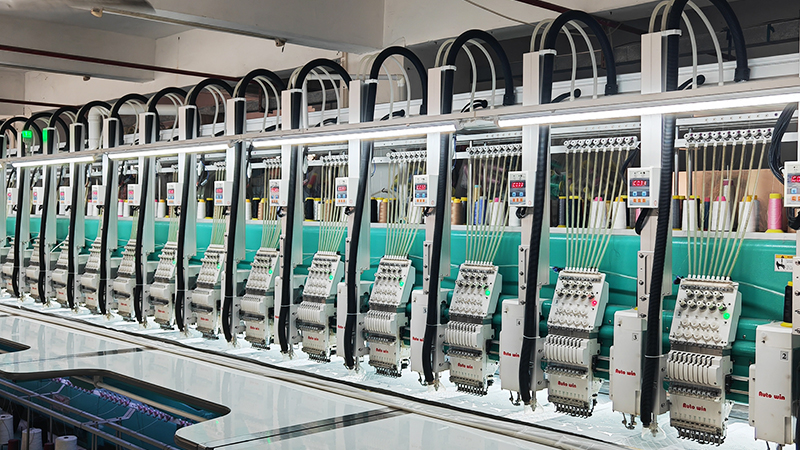
Side-mounted with reinforced laser brackets for tighter installation spaces.
Compatible with embroidery machines with 110mm+ head spacing (requires 8mm+ between needle bar frames).
- Laser peak power: 45W, 55W, 65W (three models)
- Laser spot size: <0.5mm (adjustable)
- Laser dimensions: 67 × 68 × 766 / 900 / 1050 mm
- Laser weight: 2.2kg, 2.5kg, 2.8kg
Small-Head-Distance Side-Mounted Laser Unit
Side-mounted with reinforced laser brackets for tighter installation spaces.
Compatible with embroidery machines with 110mm+ head spacing (requires 8mm+ between needle bar frames).
Technical Specifications:
- Laser peak power: 45W, 55W, 65W (three models)
- Laser spot size: <0.5mm (adjustable)
- Laser dimensions: 67 × 68 × 766 / 900 / 1050 mm
- Laser weight: 2.2kg, 2.5kg, 2.8kg
4-needle and 6-needle compact machines with 162mm narrow pitches cannot accommodate bulky conventional sensors. The miniaturized hanging design delivers full detection capabilities within ultra-restricted spaces.
Small-item embroidery operates at 1000RPM with severe vibration causing sensor misalignment. The lightweight hanging structure minimizes inertial load, ensuring detection accuracy remains uncompromised at high speeds.
Minimal head spacing causes fiber optic signal interference. The independent suspension design provides physical channel isolation, ensuring pure signal integrity for each path and eliminating false alarms.
PREV
NEXT
Our modular design philosophy unifies seven distinct mounting configurations—overhead gantry, front-beam fiber, rear-beam fiber, side-integrated, and protective tube variants—under one standardized optical core. This platform approach eliminates vendor lock-in, allowing embroidery machinery OEMs to scale from single-head prototypes to multi-head production systems without redesigning the laser delivery infrastructure.
With 50+ patents spanning optical path engineering, our proprietary fiber and protective tube routing systems achieve <3% power degradation across 10,000+ hours of operation. Whether configured for large or small head spacing, each topology is simulation-validated before physical prototyping—ensuring theoretical optimality becomes manufacturing reality.
Manufactured in our 5,000㎡ precision facility where PhD-level optical engineers oversee production, all seven configurations maintain beam pointing stability within ±0.05mm over the entire embroidery field. This is not tolerance; it is the prerequisite for our seven-gate inspection protocol.
From high-density small-head-spacing arrays to extended-reach rear-beam installations, every configuration undergoes 48-hour continuous thermal cycling validation. Our optical paths maintain power consistency across ambient temperature swings of 15°C to 45°C—critical for unconditioned factory floors in emerging manufacturing regions.
PREV
NEXT
Side-integrated and gantry-mounted variants feature vibration-decoupled optical benches that isolate beam delivery from embroidery head dynamics. The result: cutting precision remains unaffected by acceleration forces up to 3G during high-speed stitching operations.
The same laser module core migrates seamlessly between front-beam, rear-beam, and overhead configurations through standardized mechanical interfaces. Manufacturers can reconfigure production lines for different garment categories without replacing capital equipment—extending asset lifecycle value by 40%+.
Protective tube configurations employ hermetic sealing technology derived from telecom fiber standards, achieving IP54 ingress protection against textile dust and lubricant mist. For fiber-direct configurations, our armored cable assemblies withstand 100,000+ flex cycles at 50mm bend radius.
Every delivered system—regardless of mounting style—ships with a comprehensive optical performance report tracing seven critical inspection nodes. This documentation serves as the foundation for our extended warranty programs and provides audit-ready evidence of compliance with emerging laser safety regulations in EU and North American markets.
PREV
NEXT
Universal Platform Architecture
Our modular design philosophy unifies seven distinct mounting configurations—overhead gantry, front-beam fiber, rear-beam fiber, side-integrated, and protective tube variants—under one standardized optical core. This platform approach eliminates vendor lock-in, allowing embroidery machinery OEMs to scale from single-head prototypes to multi-head production systems without redesigning the laser delivery infrastructure.
Patented Beam Delivery Topology
With 50+ patents spanning optical path engineering, our proprietary fiber and protective tube routing systems achieve<3% power degradation across 10,000+ hours of operation. Whether configured for large or small head spacing, each topology is simulation-validated before physical prototyping—ensuring theoretical optimality becomes manufacturing reality.
Sub-Micron Alignment Precision
Manufactured in our 5,000㎡ precision facility where PhD-level optical engineers oversee production, all seven configurations maintain beam pointing stability within ±0.05mm over the entire embroidery field. This is not tolerance; it is the prerequisite for our seven-gate inspection protocol.
Thermal Immunity Engineering
From high-density small-head-spacing arrays to extended-reach rear-beam installations, every configuration undergoes 48-hour continuous thermal cycling validation. Our optical paths maintain power consistency across ambient temperature swings of 15°C to 45°C—critical for unconditioned factory floors in emerging manufacturing regions.
Zero-Interference Mechanical Integration
Side-integrated and gantry-mounted variants feature vibration-decoupled optical benches that isolate beam delivery from embroidery head dynamics. The result: cutting precision remains unaffected by acceleration forces up to 3G during high-speed stitching operations.
Field-Reconfigurable Scalability
The same laser module core migrates seamlessly between front-beam, rear-beam, and overhead configurations through standardized mechanical interfaces. Manufacturers can reconfigure production lines for different garment categories without replacing capital equipment—extending asset lifecycle value by 40%+.
Contamination-Resistant Sealing
Protective tube configurations employ hermetic sealing technology derived from telecom fiber standards, achieving IP54 ingress protection against textile dust and lubricant mist. For fiber-direct configurations, our armored cable assemblies withstand 100,000+ flex cycles at 50mm bend radius.
Reliability Credential Documentation
Every delivered system—regardless of mounting style—ships with a comprehensive optical performance report tracing seven critical inspection nodes. This documentation serves as the foundation for our extended warranty programs and provides audit-ready evidence of compliance with emerging laser safety regulations in EU and North American markets.



 English
